


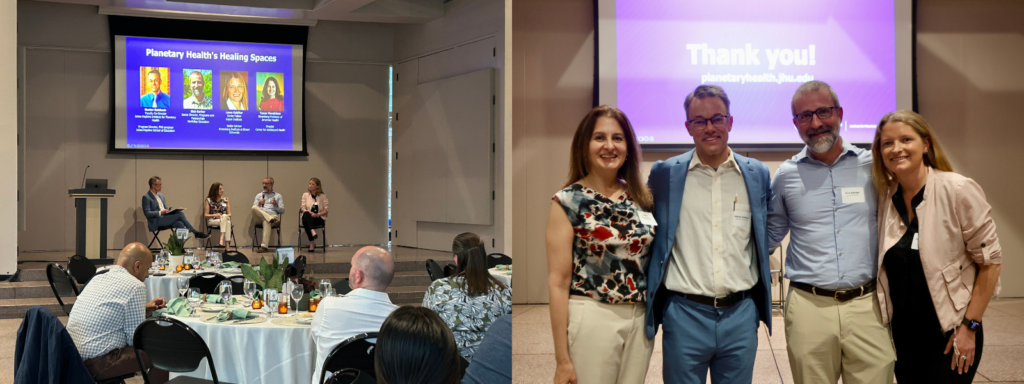
In March, the Johns Hopkins Institute for Planetary Health (JHIPH) partnered with NorthBay Education to host a dinner centered on Planetary Health’s Healing Spaces: Education, Environment, and Equity in Youth Mental Health.
The evening featured the following panelists:
- Hunter Gehlbach, Faculty Co-Director, Johns Hopkins Institute for Planetary Health; Program Director, PhD Program, Johns Hopkins School of Education (Moderator)
- Rick Garber, Senior Director, Programs and Partnerships, NorthBay Education
- Laura Schifter, Senior Fellow, Aspen Institute; Senior Advisor, Annenberg Institute at Brown University
- Tamar Mendelson, Bloomberg Professor of American Health; Director, Center for Adolescent Health
The event also featured the debut performance of Crimson Stained Plumages, a piece written by Peabody Institute sophomore Christopher Kim. Performed by fellow Peabody students Ivan Smaltsuga (flute), Gabriel Leon Guerrero (trombone), and Henry Hung (viola), the piece was written as a way to highlight the impact of man-made disasters on the environment, especially in the modern era.

Peabody Student Performance
Learn more about Crimson Stained Plumages
Performance DetailsThe Youth Mental Health Crisis
The panel opened by establishing the landscape of challenges facing today’s youth. According to panelist Tamar Mendelson, the COVID-19 pandemic shed light on a youth mental health crisis—rising rates of depression, anxiety, and other mental health conditions—that has been building for at least 15 years. Set against the social and psychological toll of the pandemic, the gravitational pull of smartphones and social media, an increasingly polarized political climate, and an escalating Earth crisis, young people today are navigating truly unprecedented stressors.
The good news is that a wealth of approaches exists for supporting youth through these challenges. Schools are a particularly important venue: from mindfulness and social-emotional learning to outdoor, field-based education, they offer opportunities to help students regulate stress, build leadership, strengthen relationships, and develop a deeper connection to the natural world.
Laura Schifter arrived at this work through a sudden personal reckoning. Seeing a news alert warning that the world had a decade to avoid climate change’s most devastating impacts, she looked at her three children and realized the problem was not distant—it was already shaping their lives. She also realized she didn’t need to leave education to contribute to solutions, and has since become a leading voice on what educational systems can do to address climate change.
Leveraging Nature to support Youth Mental Health
Research has substantially established that nature has a restorative effect on physical and mental health for students, supporting happier moods, reduced stress, better concentration, and increased feelings of empowerment, while facilitating deeper connections to community, the environment, and the future.
Rick Garber offered grounded observations from over two decades at NorthBay Education, where consistent surveying has shown that students’ disconnection from nature at baseline has grown significantly over the past decade. The measured impacts of NorthBay’s work reveal the flip side: when students spend days doing hands-on science outdoors—studying ecosystems, working together, thinking like scientists—something shifts. They come away feeling more capable and more convinced their actions matter, building the “muscle” of agency that turns anxiety into action.
Key Barriers
The central challenge, panelists agreed, is moving beyond piecemeal programs toward a cohesive vision for education that fosters both human and environmental wellbeing. In doing so, they identified several barriers to consider:
- Funding: Both for programs themselves and for preparing teachers to use outdoor and nature-based experiences meaningfully across the curriculum.
- Access and equity: Urban communities and communities of color face particular spatial barriers to nature, compounded by a changing climate that makes outdoor time less safe—more heat days, wildfire smoke, and deteriorating air quality.
- Mindset within education: Many educators don’t yet see this as their issue, and school-based climate and environmental action too often stops at the recycling bin. A deeper shift requires integrating these priorities across the whole school, including treating outdoor time as critical learning time.
- Teacher preparation: Investing in teacher preparation by giving educators the resources, training, and firsthand experience to feel genuinely comfortable outdoors is essential. A teacher who doesn’t feel at ease in a natural setting is unlikely to bring their students there.
According to the panelists, partnership is key to overcoming these barriers across schools, community organizations, state agencies, and funders. Part of what makes Planetary Health such a powerful framework is that it is expansive enough to meet people where they are. Not everyone will come to this work through the same door: for some it’s climate, for others it’s a child’s asthma, a community’s air quality, or access to clean water. The opportunity lies in identifying what resonates with each individual and channeling those varied motivations toward the shared goal of a safe, healthy future.